
Two employees, one routine follow-up call, one life saved
After a hospital stay, patient is saved by a follow-up call and two caring employees
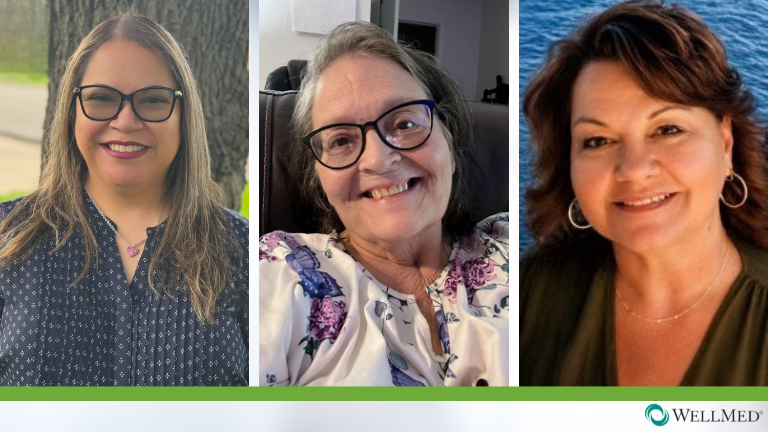
Amy Matta, Demetria Brabant and Amy Brummund
“The WellMed doctors and nurses have been so good to me. They’ve been so kind; they’ve listened and understood.”
Sometimes things go wrong.
In February, 66-year-old Demetria Brabant needed shoulder surgery. That was the easy part. Then, her carbon dioxide levels kept climbing. Clinicians discovered complications during surgery had paralyzed her diaphragm.
Breathing became a chore. Her oxygen levels began to plummet. Staff rushed her to the ICU.
About a week later, Demetria was discharged to a nursing rehabilitation facility, and then to her home in Austin, Texas, where she lives alone.
In hindsight, Demetria says, she knew she wasn’t well.
“I was dazed and confused,” she said. “My sister noticed slurred speech when I was on the phone with her. I would try to stand up from the sofa, and I’d slide right off.”
Once, her daughter and son-in-law had to call 911 for help to get her off the floor. Then, some made return trips to the hospital for serious health issues including severe asthma and congestive heart failure.
But hope and help were a phone call away.
Sometimes things go right
Amy Matta has spent more than two decades helping patients, including 18 years at WellMed at Pecan Valley in San Antonio.
Now working remotely on the contracted provider results team, Amy’s days are filled with quiet but meaningful connections. She calls patients within a couple of days after hospital discharge to ask if they’re okay and help schedule follow-up care.
On this day, what began as a routine transition-of-care call quickly became something more.
As the conversation began, something didn’t feel right. Demetria struggled to speak. Her breathing was uneven and labored. Amy’s instincts kicked in.
Gently, Amy began asking questions. Was she on oxygen? Was she having trouble catching her breath? Demetria’s answers were strained. Something was wrong.
A life-saving triage
Without hesitation, Amy reached out to her team. Another Amy in Florida, licensed practical nurse Amy Brummund, answered the call.
What followed was careful, compassionate triage. Amy B asked about chest pain, oxygen use, recent surgery, exertion and medical history. The picture became clearer, and more concerning, with every answer.
Demetria shared that her diaphragm had been paralyzed during surgery. She was alone. She felt confused. When Amy B asked her to check her oxygen, her levels had dipped dangerously low.
“You need to go to the ER,” Amy B said, her voice steady but urgent.
Demetria hesitated. She didn’t want to bother her daughter, who works full time. She didn’t want to call on a neighbor.
Amy B continued in a calm and reassuring tone. “I don’t think you should wait,” she said. “Your symptoms are serious.”
Demetria said she would call 911. The call dropped, suddenly.
Amy B called back. No answer. She called local emergency responders and learned Demetria had gotten through to 911. An ambulance was already at her home.
Diagnosis and relief
Amy B breathed a sigh of relief. The next morning, she called Demetria, who had been admitted to the hospital. Doctors discovered she had been suffering from oxygen deprivation and secondary respiratory failure due to dangerously high carbon dioxide levels.
Today, Demetria is off oxygen and reporting normal oxygen levels. She got the help she needed because two women listened, trusted their instincts and acted quickly.
“The WellMed doctors and nurses have been so good to me,” Demetria said. “They’ve been so kind; they’ve listened and understood.”
Amy Matta doesn’t consider what she and Amy Brummond did to be extraordinary.
“I was worried,” she said. “I wanted to make sure she was okay. That’s what I do.”
For both Amys, this was about doing their jobs with heart, with urgency and with the belief that every patient call is more than just a call. Sometimes, it’s an opportunity to make sure things go right.
Sometimes, it’s a lifeline.
Your health is important to us
Interested in learning more about WellMed? We are happy to help. Please contact our patient engagement team at 1-866-323-3601 to schedule an appointment, schedule a clinic tour, RSVP for an event or be connected with a licensed insurance agent.
For all other inquiries, contact WellMed Customer Service at 1-877-370-8115.
Online: By completing and submitting the “Request an appointment” form, you consent to WellMed contacting you to provide the requested information.
Representatives are available Monday through Friday, 8 a.m. to 6 p.m. CST.
New and existing patients
Request an appointment
"*" indicates required fields


