
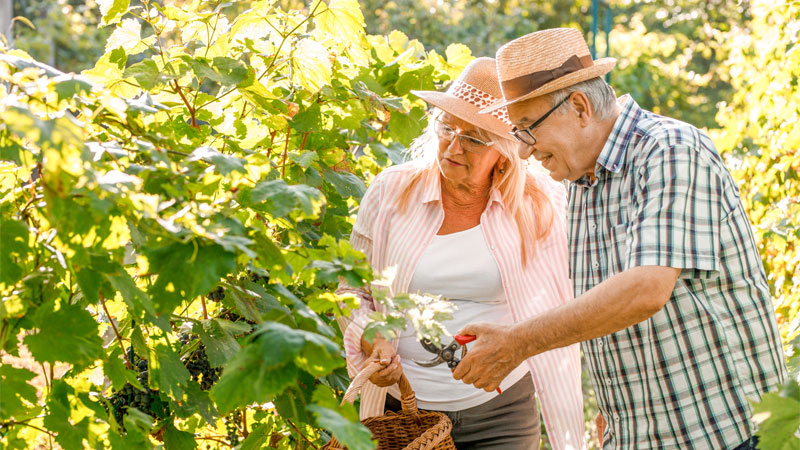
You may think of gardening as a hobby: a way to grow tomatoes, plant flowers or make the yard look nice.
For many people, it is exactly that. That said, it can also become part of how you unwind.
It gets you outside, adds a little movement to the day and gives you something to care for. Over time, that may help support mental health.

Become a patient
Our primary care team is here to give you the focused support you need.
Find a clinicResearch suggests the mental health benefits of gardening may include better well-being and quality of life.1
That can matter at any age. It may matter even more as you get older, when daily routines, sleep, energy and social connection can all affect how you feel.
Why gardening may help in the first place
Gardening does not look like much from the outside. You water a pot, pull a weed or check on a plant you thought might not make it.
However, small habits can shape your day. Gardening gives you a reason to step outside and pay attention to something other than your to-do list. That may help you feel calmer, more focused or a little less alone.
Those benefits can show up in different ways.
1. Gardening can lower stress
Stress does not always hit all at once. Sometimes it builds quietly from health worries, bills, family demands, poor sleep or just too much going on at one time.
Gardening can help take the pressure down a notch.
Working with plants is calming. You might water dry soil, trim herbs or spot a bud that was not there yesterday. These are small things, but they can pull your attention away from everything else for a few minutes. That pause can help.
Studies have found that gardening and horticultural activities may help reduce stress.2
You need not spend half the day outside to reap benefits. A few minutes in the morning or evening may be enough to break up a stressful day.
2. It may ease symptoms of depression
Depression is not just sadness. It can change how you feel, how you think and how hard it is to get through an ordinary day.
That is why gardening may help. It allows you to manage just one small, manageable task a day. Just one thing. Water a plant. Pull a few weeds. Move a pot into better light.
In older adults, horticultural therapy has been linked to lower depressive symptoms.3
Gardening can also give you something depression often takes away, which is a sense that something is moving forward. A seed sprouts. A drooping plant looks better after watering. A flower opens. When your mood is low, that kind of change can feel meaningful.
3. Gardening can help calm anxiety
Anxiety has a way of dragging your mind into the future. What if something goes wrong? What if you forgot something? What if the news is bad?
Gardening brings you back to what is in front of you.
Maybe one pot needs water. Maybe a plant needs more sun. Maybe a few leaves need to be trimmed back. The task is simple, and sometimes that is exactly what helps.
Reviews of the research suggest gardening may also help reduce anxiety.4
It can help in another way, too. Gardening teaches patience, whether you want that lesson or not. Seeds take time. Flowers open when they are ready. You do what you can, then wait. For people who live with worry, that can be a useful shift.
4. A stronger sense of purpose
Mental health is not only about feeling less stressed or less sad. It also has a lot to do with feeling useful and connected to something beyond yourself.
Gardening can help with that.
Plants need regular care. You water them. You check to see how they are doing. Sometimes they need more sun. Sometimes they need a little less. Over time, caring for them can become part of your day, giving you a sense of purpose.
This can matter even more as you get older, especially after retirement, after an illness or when your day feels less full than it once did. In older adults, gardening has been linked to greater feelings of connection and a stronger sense of purpose.5
5. Support for focus and brain health
Gardening is physical, but it keeps your mind busy.
You have to remember what you planted, keep track of what needs water and notice what is changing from week to week. You start to learn which spots get the most sun and which plants need a little more attention.
Gardening may support cognitive function in older adults. Even a short gardening activity is linked to changes tied to brain health. People who garden have better cognitive status, though mood and physical activity may explain part of that link.6
That does not mean gardening prevents dementia. But it may help keep the mind active in a way that feels natural and useful.7
6. Less loneliness, more connection
Loneliness can affect health in many ways. It can weigh on your mood, raise stress, affect sleep and make daily life feel harder.
Gardening can help you feel more connected.
Sometimes that starts with the plants themselves. Having something alive to check on and care for can make the day feel less empty. Other times, the connection comes from people around you. A neighbor asks what you are growing. A grandchild helps water the plants. You share herbs with a friend or talk with someone at a community garden.
Social connection matters as you get older, and the CDC notes that social well-being is an important part of healthy aging.8
Gardening can be a good shared activity for caregivers, too. You do not have to talk the whole time. Sometimes it is enough to just work side by side.
7. Better sleep over time
Sleep and mental health affect each other every day. Stress can make it hard to fall asleep. Anxiety can wake you up at night. Poor sleep can make everything feel harder the next morning.
Gardening may help with sleep in a few simple ways. It gets you moving, gives you time outside and can leave you feeling more settled by the end of the day.9 For some people, that can make it easier to relax at night and sleep better.
How to start gardening in a small space
You do not need a yard to garden. A porch, patio, balcony or bright window may be all you need.
If you are new to gardening, start small. One or two plants are plenty. Basil, parsley, mint, lettuce, marigolds, zinnias and cherry tomatoes are all good starter options for many people. Use potting soil, check the plant tag and water when the soil feels dry.
You might begin with herbs in a kitchen window, flowers in lightweight pots, a railing planter on a balcony, one tomato plant in a large container or a small tabletop planter near a sunny door.
A plot in a community garden can work too.
You also do not have to grow food for gardening to be worth it. Flowers, herbs and other plants can bring the same sense of calm, routine and enjoyment.
How to garden with limited mobility
Gardening should fit your body, not the other way around.
If bending, kneeling or lifting is hard, you still have options. Raised beds can help. So can tall planters, rolling garden stools, self-watering containers and lightweight watering cans.
It can also help to break the work into smaller tasks. Water one day. Trim another day. Repot one plant instead of several.
If you need help, that is okay. Ask a friend or family member to handle the heavier work while you choose plants, start seeds, clip herb or check on the pots.
Even sitting near plants, touching the leaves or spending time outdoors with them can still feel calming.
Safety tips for gardening
Gardening is healthy, but it is still a physical activity.
Try to avoid the hottest part of the day. Drink water before and during your time outside. Wear gloves, sunscreen, a hat and sturdy shoes. Take breaks when you need them. Do not lift heavy bags of soil by yourself.
If you have heart disease, lung disease, balance problems, arthritis or another chronic condition, ask your doctor what level of activity is safe for you.
When to talk with your doctor
Gardening can support your mental health, but it should not take the place of care from your doctor.
Talk with your doctor if sadness lasts more than two weeks, you lose interest in daily life, you feel constant worry or panic, your sleep or appetite changes, you start withdrawing from other people or it becomes hard to get through the day.
Medicare covers annual depression screening in qualifying primary care settings, along with many outpatient mental health services when they are medically necessary. If something feels off, say something. It is worth the conversation.10
The bottom line
Gardening is simple, and that is part of what makes it helpful.
It can lower stress, ease symptoms of depression, calm anxiety, give you a sense of purpose, support focus, reduce loneliness and help you sleep better.
These gardening and mental health benefits are one reason this simple habit is worth trying, especially as you get older or if you care for an older adult. You do not need a big yard or a lot of time to get started. A few pots, one herb plant or a little time outside can be enough.
References
- 1. Panțiru, I., A. Ronaldson, N. Sima, A. Dregan, and R. Sima. “The Impact of Gardening on Well-Being, Mental Health, and Quality of Life: An Umbrella Review and Meta-Analysis.” Systematic Reviews 13 (2024): 45. https://pmc.ncbi.nlm.nih.gov/articles/PMC10823662/
- 2. Lu, Shan, Jianjiao Liu, Meijing Xu, and Feng Xu. “Horticultural Therapy for Stress Reduction: A Systematic Review and Meta-Analysis.” Frontiers in Psychology 14 (2023): 1086121. https://pmc.ncbi.nlm.nih.gov/articles/PMC10411738/
- 3. Xu, Meijing, Shan Lu, Jianjiao Liu, and Feng Xu. “Effectiveness of Horticultural Therapy in Aged People With Depression: A Systematic Review and Meta-Analysis.” Frontiers in Public Health 11 (2023): 1142456. https://pmc.ncbi.nlm.nih.gov/articles/PMC10031070/
- 4. Soga, Masashi, Kevin J. Gaston, and Yuichi Yamaura. “Gardening Is Beneficial for Health: A Meta-Analysis.” Preventive Medicine Reports 5 (2016): 92-99. https://pmc.ncbi.nlm.nih.gov/articles/PMC5153451/
- 5. Scott, Theresa L., Barbara M. Masser, and Nancy A. Pachana. “Positive Aging Benefits of Home and Community Gardening Activities: Older Adults Report Enhanced Self-Esteem, Productive Endeavours, Social Engagement and Exercise.” SAGE Open Medicine 8 (2020): 2050312120901732. https://pmc.ncbi.nlm.nih.gov/articles/PMC6977207/
- 6. Wang, Kaiyue, Yaqi Li, Xiao Chen, Susan Veldheer, Chen Wang, Han Wang, Liang Sun, and Xiang Gao. “Gardening and Subjective Cognitive Decline: A Cross-Sectional Study and Mediation Analyses of 136,748 Adults Aged 45+ Years.” Nutrition Journal 23 (2024): 59. https://pmc.ncbi.nlm.nih.gov/articles/PMC11149237/
- 7. Park, Sin-Ae, A-Young Lee, Hee-Geun Park, and Wang-Lok Lee. “Benefits of Gardening Activities for Cognitive Function According to Measurement of Brain Nerve Growth Factor Levels.” International Journal of Environmental Research and Public Health 16, no. 5 (2019): 760. https://pmc.ncbi.nlm.nih.gov/articles/PMC6427672/
- 8. Centers for Disease Control and Prevention. “Healthy Aging at Any Age.” Last modified September 3, 2024. https://www.cdc.gov/healthy-aging/about/index.html
- 9. Mahalakshmi, B., N. Siva Subramanian, and A. Navaneetha Krishnan. “Impact of Horticulture Therapy on Sleep Quality in Geriatrics.” Bioinformation 21, no. 10 (2025): 3518-21. https://pmc.ncbi.nlm.nih.gov/articles/PMC12859293/
- 10. Centers for Medicare & Medicaid Services. “Screening for Depression in Adults (CAG-00425N) – Decision Memo.” October 14, 2011. https://www.cms.gov/medicare-coverage-database/view/ncacal-decision-memo.aspx?NCAId=251&proposed=N&